
8 Unexpected Gallery Wall Ideas Around Your Wooden Tree Bookshelf
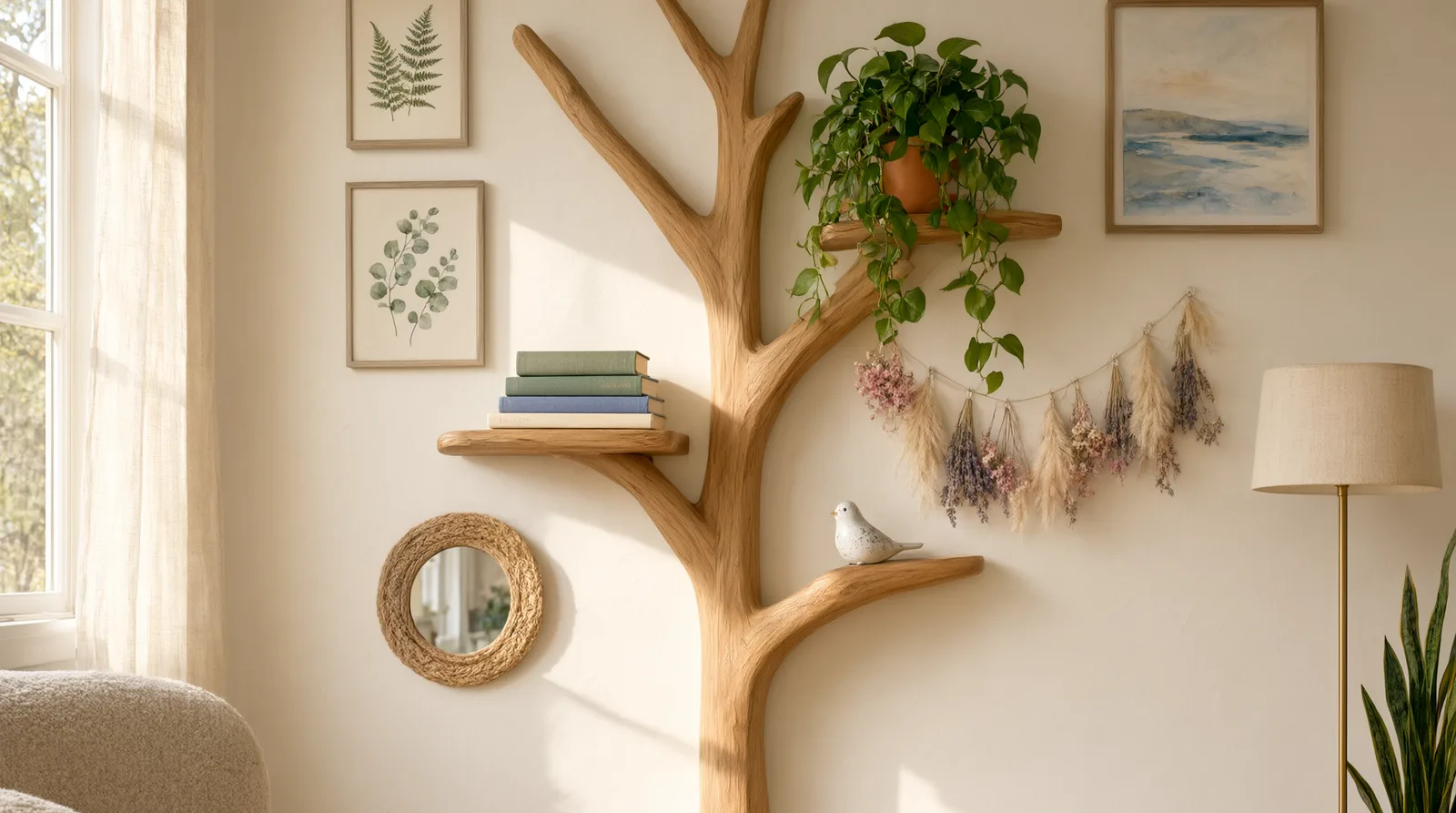
If your walls still feel flat despite having a beautiful wooden tree bookshelf, you might be framing the problem wrong. The shelf itself is a sculptural, organic shape—so treating it like a rectangular bookcase and hanging a grid of same-size frames around it will always look mismatched. A gallery wall built around a tree bookshelf isn't about matching lines; it's about letting the asymmetrical branches lead the entire composition.
When you treat the shelf as the living centerpiece of a gallery wall tree bookshelf display, you unlock a layout that standard shelves can never replicate. The branches create natural frames and movement, making the surrounding art feel like an extension of the tree rather than a separate collection. This approach turns a functional storage piece into the heart of a curated, organic wall installation that grows with your style.
Why a Tree Bookshelf Belongs at the Center of Your Gallery Wall
The rigid grid that works for a traditional gallery wall fights against everything a wooden tree bookshelf represents. Its asymmetric silhouette, with branches that sweep upward and outward, naturally breaks any attempt at perfect symmetry—and that's the point. Your eye doesn't have to work to find a focal point because the organic shape of the tree provides an immediate visual anchor that's far more interesting than a centered rectangular frame.
Beyond the visual appeal, this is also a deeply practical choice. A tree bookshelf does double duty as both storage and the largest piece of "art" in your arrangement. Unlike a wall of floating shelves that demands you fill every ledge to justify their presence, the sculptural silhouette speaks for itself. The branches provide built-in negative space and framing cues, removing much of the guesswork that usually makes gallery walls feel intimidating. You're not starting from a blank wall—you're responding to a form that already has movement, personality, and a clear directional flow.
Trail the Branches Outward with Botanical Prints and Found Objects
Look closely at how the branches on your shelf extend and curve. Those lines are your template for placing art. Trace a branch with your eye and continue that arc onto the wall with pieces that echo the organic movement—a framed botanical print with trailing ivy, a vine-like garland draped in a gentle curve, or even a framed piece of calligraphy with flowing, scripted lines. The goal is to make the wall feel like the tree is still growing and reaching beyond its wooden form.
This is where the idea that anything can become art, as explored by Real Simple, turns into a genuinely useful styling tool. Don't limit yourself to prints and paintings. A beautifully weathered piece of driftwood, a woven sun hat with a natural straw texture, or a small hand broom with curved bristles can all hang on the wall like sculptural art pieces. These found objects reinforce the organic theme and cost next to nothing, giving you permission to experiment. Place smaller frames and lightweight objects closest to the branch tips, and graduate to larger pieces as you move outward, mimicking how leaves cluster densely near the trunk and spread lightly at the edges.
Create a Seasonal 'Gallery' That Rotates with Your Shelf Display
A gallery wall doesn't have to be static. In fact, building your wall around a tree bookshelf invites a seasonal rhythm that makes your whole space feel more alive. Rather than redesigning from scratch every few months, let the bookshelf's decor set the tone for the entire wall display. If you style the Wooden Sakuridge Tree Bookshelf with soft pinks and delicate blossoms for spring, let the surrounding gallery shift to pastel floral prints and lightweight linen wall hangings. When autumn calls for richer tones, swap those out for deep orange leaf prints and warm textile art.
For renters or anyone cautious about wall damage, this rotation system is freeing rather than burdensome. Use lightweight, easy-to-swap items like postcards tucked into clip frames, fabric squares stretched over canvas boards, or small woven baskets hung with adhesive hooks. These pieces can be changed in under an hour without patching a single hole. The key to keeping the seasonal shifts from feeling chaotic is to keep one large, constant element—perhaps an oversized botanical canvas or a round mirror—while cycling only the smaller accent pieces around it. That anchor provides continuity, and the tree shelf itself remains the reliable center of the arrangement.
Mix Media: Sculptural Pieces, Mirrors, and Woven Textures
Wood brings warmth, but a gallery wall that's all wood-toned frames and wooden decor can start to feel heavy. Introduce balance by mixing in completely different materials. A small, round mirror with a thin metal rim placed among the frames catches light and reflection, which is particularly effective when positioned near a bookshelf with distinctive, separated branches. The Wooden Eldrasyl Tree Bookshelf has an open, airy branch structure that practically begs for a mirror to bounce light into its nooks, making the whole installation feel deeper and more dimensional.
Ceramic wall hangings, a hand-knotted macramé piece, or a hammered metal sunburst add texture that contrasts with the smooth or carved wood of your shelf. True gallery walls aren't flat—they're assemblages that break the plane of the wall, cast gentle shadows, and invite touch. A three-dimensional object, like a small woven basket hung flat against the wall or a ceramic bird mounted as if perched, creates the kind of subtle, shifting shadow play that changes throughout the day as natural light moves through the room. This dimensionality is what separates a thoughtfully curated wall from a simple collection of frames.
Anchor the Wall with One Oversized Statement Piece
A common instinct is to center the bookshelf on the wall and scatter art symmetrically around it, but that often feels stiff. The tree form itself is asymmetrical, and pairing it with a large, off-center artwork creates a more dynamic and intentional balance. Think of the bookshelf and the oversized piece as co-stars rather than a lead and backup. A substantial framed botanical chart, a woven tapestry, or a large abstract canvas placed slightly to the left or right of the shelf's widest point can ground the entire gallery wall tree bookshelf composition.
This off-center anchoring works beautifully with highly sculptural shelves like the Wooden Arborwyn Sculpted Tree Bookshelf. Its pronounced, sweeping branches have enough visual weight to hold their own against a large neighboring piece, so the wall never feels lopsided. The golden rule for breathing room is simple: leave at least a palm's width of space between the shelf's outermost branch tip and the edge of the large frame. This sliver of wall lets each element stand on its own while still reading as part of a unified grouping, preventing the dreaded cluttered-overlap look.
Building Your Nature Gallery Without a Single Nail Hole
Renting shouldn't mean resigning yourself to bare walls. The art surrounding your tree bookshelf can hang entirely damage-free if you choose the right methods and hardware. Command strips come in a wide range of weight ratings—from strips that hold a few ounces for paper-thin postcards to large picture-hanging strips that can securely hold a framed canvas. For especially lightweight or irregularly shaped objects like a woven hat or a piece of driftwood, adhesive putty pressed into the back corners provides enough grip without any permanent alteration. I've covered these renter-friendly strategies in detail before with our Renter-Friendly Tree Bookshelf ideas, and the same principles apply to the gallery wall around it.
Don't overlook the bookshelf itself as a hanging tool. The flat vertical surfaces of the trunk or thicker branches can act as a leaning ledge for small framed art. Prop a 5x7 inch frame of a pressed leaf directly against the wood, and it looks intentionally displayed without any adhesive or nail touching the paint. Combining a few leaned pieces on the shelf with a handful of deeply spaced, command-strip-mounted items on the surrounding wall creates a relaxed, collected-over-time feel. And remember, the bookshelf itself is the central feature—available through our Bookcases & Standing Shelves collection—and it stands on its own. That already eliminates half the wall-damage concern you'd face when trying to mount a series of separate floating shelves to achieve a similar look.
A wooden tree bookshelf is more than a clever storage solution—it's the starting point for a wall display that feels personal, organic, and full of life. By letting the branches guide your gallery layout, mixing in unexpected materials, and embracing seasonal change, your wall will always feel like a true reflection of your home. Explore our full collection of sculptural shelves to find the piece that will root your gallery wall in style.
Frequently asked questions
Can I build a gallery wall around a tree bookshelf in a small room?
Yes, and it can actually make the room feel larger. The vertical, upward-reaching branches draw the eye high, which creates a sense of height. Use smaller frames and lighter colors on the surrounding wall to keep the installation feeling airy rather than heavy.
How many pieces should I hang around my tree bookshelf?
Start with three to five pieces and let the composition breathe. An odd number generally feels more natural and less staged, especially around an organic shape. You can always add more over time as you find objects you love, but forced symmetry can fight the tree's natural silhouette.
What if my tree bookshelf is already full of books and plants?
A styled shelf is actually an asset to your gallery wall. The objects on the shelves become part of the overall composition. Just make sure a few of those shelf items—like a trailing plant or a standing small frame—"point" outward, visually linking the shelf's contents to the art on the wall.
Is a wooden tree bookshelf sturdy enough to lean frames against?
Absolutely. Flat sections of the trunk and thicker lower branches provide stable surfaces for leaning small, lightweight frames. This is one of the easiest ways to add a layered look without using any wall fasteners at all, and it works with any well-built wooden shelf.
How do I keep a mixed-material gallery wall from looking cluttered?
Stick to a cohesive color palette of two or three main tones across all your materials. For example, combine warm wood, cream ceramics, and touches of black metal for a unified look. Repeating one shape, like circles through a round mirror and woven circular baskets, also creates visual order amid the variety.