
High-Fidelity Listening Nook: Pairing Speakers with a Wooden Tree Bookshelf
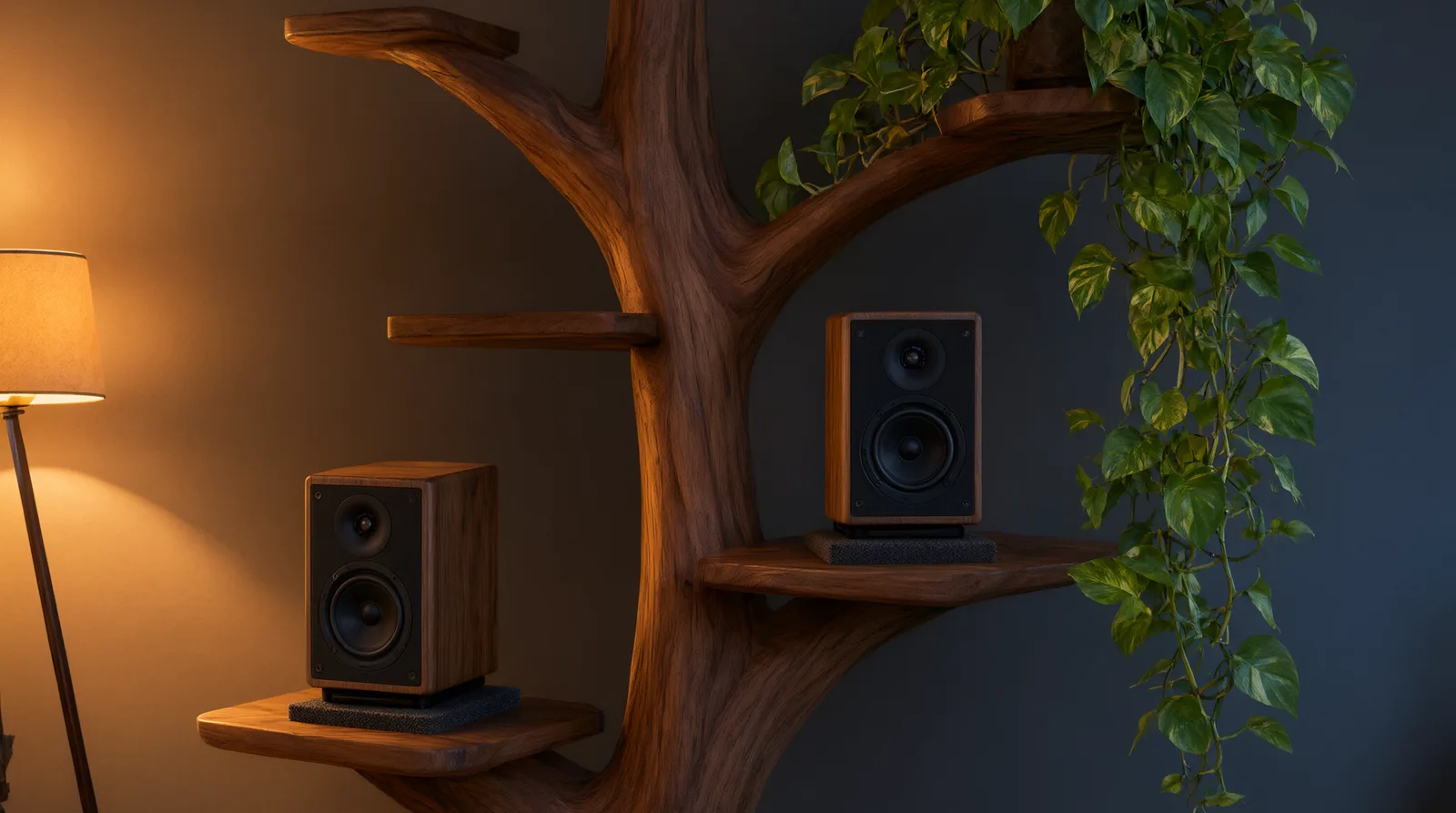
Great sound doesn't have to come with a side of black-box dullness. If you've just brought home a pair of revealing compact speakers and find yourself staring at a generic media console that kills the vibe, it's time to rethink the centerpiece. A wooden tree bookshelf speakers setup treats your audio gear as part of the art, turning a functional corner into a high-fidelity listening nook that feels intentionally curated rather than technically cluttered.
The recent spotlight on compact, detail-rich designs, like the discounted Q Acoustics 5010 speakers noted by Technobezz, proves that great sound now comes in living-room-friendly packages. These smaller cabinets beg for a display that matches their precision, and an open, sculptural shelf does exactly that—celebrating the gear instead of hiding it.
Why a Wooden Tree Bookshelf Belongs in Your Listening Room
The warm, natural sound signature many bookshelf speakers are designed to produce finds a visual and acoustic partner in solid wood. Unlike a cold metal rack, a wooden tree bookshelf contributes a subtle, organic resonance that pairs beautifully with the tonal character of compact passive or powered speakers. The shelf's organic form complements the idea that you're listening through the system to the music, not just analyzing the equipment.
Aesthetically, a tree bookshelf transforms the utilitarian speaker stand into a room-defining focal point. Where standard stands scream "audio hardware store," a model like the Wooden Arborwyn Sculpted Tree Bookshelf turns your speakers into elements of a whimsical sculpture. There's also a deeply practical benefit: integrated shelves place your vinyl records, a compact turntable, or remote controls within arm's reach on a lower branch, embracing the philosophy of living with your gear rather than stashing it behind closed cabinet doors.
Speaker Placement on an Asymmetrical Shelf
A tree bookshelf doesn't hand you a single flat surface, which is actually a creative opportunity for a wooden tree bookshelf speakers layout. You must choose a stable, level branch or shelf platform for each speaker separately. Look for the widest, flattest sections of the canopy or trunk that sit at similar heights—visual symmetry matters less than acoustic balance here, but a shelf with a structured four-point spread, like the Wooden Branoris Tree Bookshelf, makes this much easier.
To nail the stereo image, aim to get the tweeters roughly at ear height from your primary listening chair, using the different tier levels creatively. This might mean placing the left speaker on a slightly higher "branch" and the right on a matching one further down, angling each toward your ears. Isolation is non-negotiable: generic dense foam pads or small sorbothane pucks placed under each speaker decouple it from the wood, preventing the shelf itself from becoming a resonating soundboard that blurs detail. If you're using rear-ported speakers, give them at least a few inches of breathing room within the open structure, and avoid pushing a wall-mounted tree shelf so flat against the wall that it chokes the port.
Wiring Without Spoiling the Sculpture
The whimsical silhouette of a tree bookshelf falls apart when black plastic cables zigzag across it. The fix is simple: switch to braided or fabric-sleeved speaker cables in a color that echoes the wood—a dark espresso cable on a walnut shelf, or a natural linen sleeve on a lighter oak, all but disappear. For shorter runs, flat, white adhesive cable channels can blend with a white wall behind the shelf.
Route the cables along the back edges of the "trunk" and up the "branches" using clear, removable adhesive clips that won't damage the finish. The goal is to hide the path at the rear while leaving the front view completely clean. To keep visual clutter to an absolute minimum from the start, consider a minimal Class D stereo amplifier tucked on a lower shelf or opt for powered speakers that require only a single power cable to one unit, preserving the sculptural illusion of the Wooden Eldrasyl Tree Bookshelf.
Curating Your Listening Nook Around One Shelf
Think of the lower, wider "roots" or trunk base as your operational zone. A small selection of your most-played vinyl leaning on a lower tier, or a compact turntable perched securely on a reinforced shelf, anchors the setup and signals the nook's purpose. The Bookcases & Standing Shelves collection offers a variety of shelf layouts, so you can choose one with a dedicated spot for a record crate right from the start.
On the remaining branches, less is definitively more. One trailing plant in a light, porous pot, a small woven textile art piece, or a single cherished object personalizes the nook without introducing hard, flat surfaces that create problematic sonic reflections. For lighting, a dimmable, warm-toned floor lamp positioned just beside the shelf, or a tiny clip-on LED spotlight aimed at the wood grain, makes the cabinets glow during evening listening sessions and reinforces the ritual of sitting down to listen.
Balancing Acoustics and Decor on an Open Shelf
An open, branch-like structure is inherently an acoustic advantage over a boxy media console. It eliminates the large, flat surfaces directly adjacent to your speakers that cause early, smearing sound reflections. Every "branch" acts as a diffuser, breaking up sound waves in a way that can actually enhance the sense of space in your music.
Style the remaining empty perches with soft, irregular items that absorb rather than reflect. A small woven basket holding remote controls, a wool throw folded on a lower branch—these materials manage flutter echo naturally. Avoid the urge to pack every shelf with hardcover books serving purely as decor right next to the speakers; stacked paper can diffract the sound and muddy a precise stereo image. The solid wood construction of a quality shelf like the Wooden Sylvenoak Tree Bookshelf also provides far more solid, non-resonant support than a flimsy metal or tempered glass stand, keeping the bass tighter and cleaner.
From Shelf to Sanctuary: Lighting and Ambience
Layered lighting transforms the nook from a functional piece of furniture into a sensory sanctuary as daylight fades. Pair a dimmable floor lamp beside the shelf with a tiny, warm-white LED puck discreetly tucked among the canopy branches; the dual source depth highlights the tree's three-dimensional form. The warm color temperature—stick around 2700K—brings out the rich, natural character of the wood, whether it's a dark walnut or a lighter oak finish.
This intentional lighting design reinforces a powerful habit. A dedicated, beautifully styled listening nook that glows at the touch of a switch encourages more focused, intentional music listening. It carves out a daily retreat where you sit with an album, not just hear it, turning a corner of a room with a Wooden Sakuridge Tree Bookshelf and a pair of fine speakers into the most restorative spot in your home.
Frequently asked questions
Can a wooden tree bookshelf hold the weight of heavy bookshelf speakers?
Most solid wood tree bookshelves are built to hold a significant amount of weight, often supporting a turntable or a stack of vinyl records. It's wise to check the specific weight capacity of the shelf you choose and place heavier speakers on the thickest, most reinforced lower branches or trunk areas to keep the center of gravity low and stable.
Will placing speakers on a tree shelf cause buzzing or vibrations?
It can if you place the speaker cabinet directly on the wood without any isolation. Using dense foam pads, rubber isolation feet, or sorbothane pucks between the speaker and the shelf decouples the two, absorbing micro-vibrations and preventing the wood from acting as a secondary sounding board, which keeps the bass clean and detailed.
Is a tree bookshelf worse for sound than dedicated speaker stands?
It can actually offer acoustic advantages if set up thoughtfully. A quality solid wood shelf provides a rigid, low-resonance base, and the open, irregular branch structure avoids the large reflective surfaces found on a typical media console that cause early sound reflections, potentially giving you a clearer, more open soundstage than a boxy piece of furniture. Dedicated stands are ideal for ultimate fine-tuning, but a well-implemented tree shelf is a beautiful and competent alternative.
How do I choose the right tree bookshelf for my speakers?
Look for a model with several wide, flat platform areas rather than just thin, angled branches. The platforms need to be large enough to physically accommodate your speaker's footprint with a little extra space behind them if your speakers are rear-ported. A design with a sturdy, wide base and a layout that offers two platforms at a similar height will make setting up a proper stereo image much easier.