
6 Designer Rules for Styling a Tree Bookshelf as a Room’s Focal Point
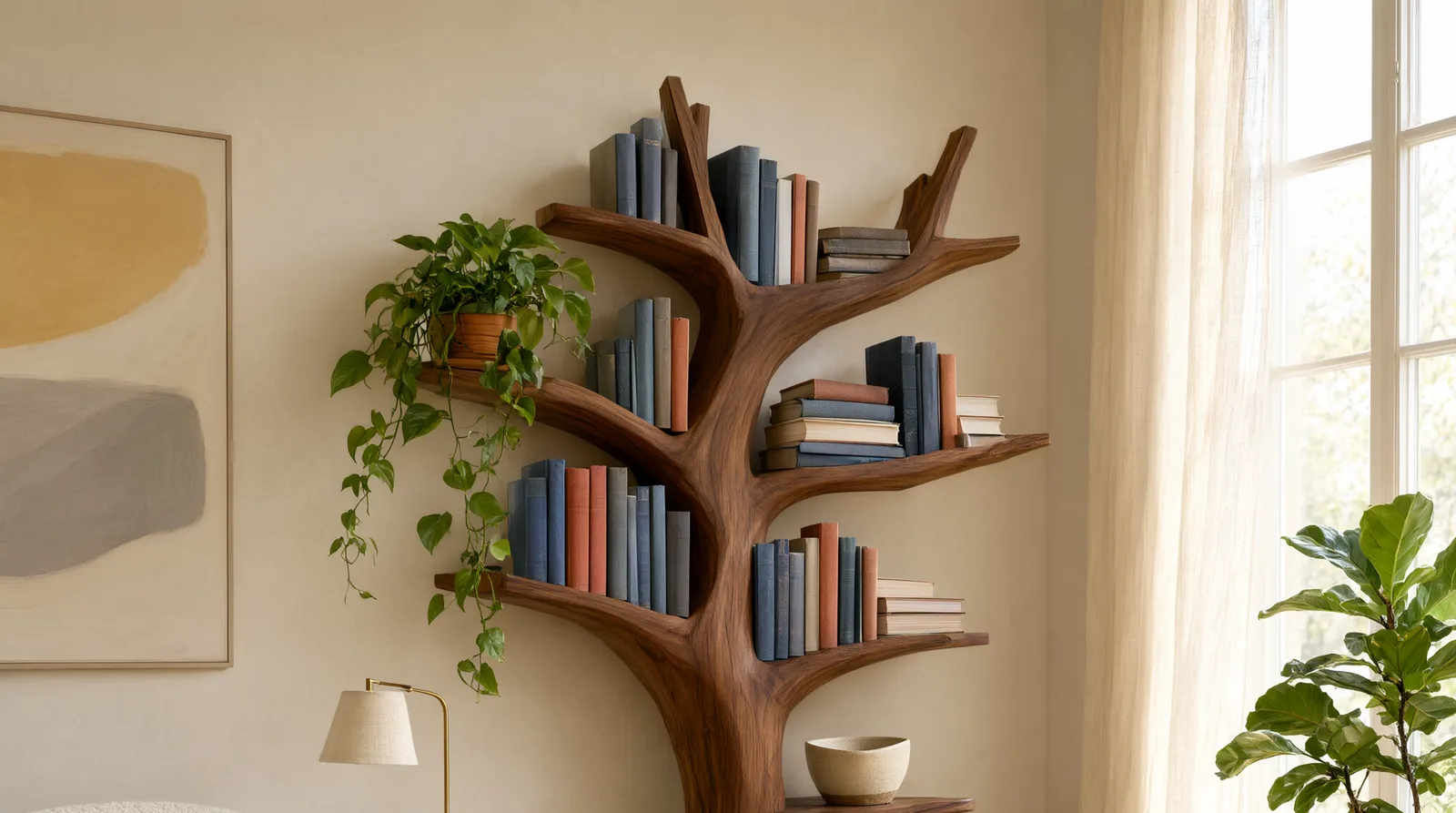
A sculptural wooden tree bookshelf is more than storage—it’s tree bookshelf interior design at its most expressive. Unlike a standard rectangular bookcase, its organic branches and asymmetrical silhouette already command attention before a single object touches it. The goal of styling isn’t to fill every surface, but to amplify the form so it anchors the room with intention.
Designers know that a piece this distinctive needs a different rulebook. Where a flat-pack shelf forgives density and uniformity, a tree bookshelf reveals every choice. The following six principles—drawn from professional practice and the latest designer insights—will help you turn yours into a room’s focal point without clutter or kitsch.
Why a Sculptural Tree Bookshelf Demands a Different Styling Approach
Tree bookshelf interior design begins with a fundamental shift: you’re not filling shelves, you’re curating a sculpture. A wooden tree bookshelf reads as architectural art the moment it’s installed. Its branches sweep outward at varied depths, the trunk grounds the composition, and the open sightlines pull the eye across the whole form. The moment you treat it like a generic bookcase—lining up identical rows of spines—you mask the very silhouette that makes it special.
Designers call this the rule of respecting negative space. On branched shelving, empty zones are not mistakes; they’re breathing room. A branch tip left bare lets the wood’s curve complete the visual sentence, while a too-packed shelf competes with the natural line. As Veranda recently noted, top interior designers treat a statement shelving unit as “functional art,” not mere storage furniture. That mindset transforms the shelf from a loaded prop into a deliberate focal point.
Layer Objects by Visual Weight, Not by Category
Visual weight—how dark, dense, or large an object reads from across the room—determines where it belongs on a tree bookshelf. Designers place the heaviest visual pieces near the trunk or on the lowest, sturdiest branches to ground the unit. A stack of thick art books on the base shelf, for instance, prevents the silhouette from feeling top-heavy and provides a stable foundation for the lighter elements above.
Along a single branch, you can group items of similar visual weight, then interrupt the rhythm with one airy element that holds the eye. A row of leather-bound classics suddenly gains energy when a slender stem vase sits at the branch tip, almost as if the branch itself is offering it. Spindly branch ends should never carry chunky objects—they suit small, translucent, or delicate pieces like a glass bud vase, a taper candle, or a single framed print leaning lightly. On Lunelleify designs like the Wooden Eldrasyl Tree Bookshelf or the Wooden Sylvara Flow Tree Bookshelf, curved branch paths especially reward leading the eye through color-weight shifts rather than uniform rows.
Mix Horizontals and Verticals to Keep the Sculpture Alive
Tree branches are inherently directional, and your styling should echo that energy. Designers stack some books horizontally to create visual “rest stops” and stand others vertically to continue the upward line of a branch. A short horizontal stack near a branch joint can act as a pedestal for a small sculptural object—a technique that works beautifully on branching models like the Wooden Arborwyn Sculpted Tree Bookshelf or the Wooden Branoris Tree Bookshelf.
Resist the urge to line up all books like soldiers. A rigid, all-vertical row kills the organic whimsy of a tree bookshelf. Mixing orientations respects the natural asymmetry and keeps the composition from slipping into furniture-showroom predictability. A practical note: horizontal stacks work best on wider shelf platforms at trunk level or major branch forks, while narrower branch ends are often better left to a single vertical grouping or a lone object.
Use Live Greenery, Not Just Decor, to Make the Form Sing
Nothing punctuates a tree-shaped silhouette more naturally than a few actual plants. They reinforce the arboreal theme without turning the shelf into a theme-park prop. A trailing plant like pothos or string of pearls placed on an upper branch lets the cascade mimic organic growth, softening the wood edge. Veranda’s designers often use “living elements” to break up hard lines on sculptural shelves, and a tree bookshelf is the ideal canvas for this trick.
Restraint is key. One well-positioned trailing plant and one upright specimen—a small snake plant tucked onto a low trunk shelf, for example—are enough. Too many pots read as a plant stand, not a styled bookshelf. If you use real plants, always place them in drip-proof pots with saucers to protect the wood. Dark corners that get no natural light can host a botanically believable silk alternative, but keep it subtle; you want the greenery to support the wood, not fake a forest.
Anchor the Shelf to the Room With One Dialogue Object
Designers use a “dialogue object” to make a statement piece feel integrated rather than isolated. This is something elsewhere in the room—on a coffee table, mantel, or adjacent wall—that shares a color, material, or curved form with an object on the bookshelf, creating an invisible connective line. A ceramic lamp echoing the ochre of a vase on a middle branch, or an arched mirror on the opposite wall nodding to the tree’s curved boughs, instantly ties the composition into the broader design.
This technique turns the tree bookshelf into a co-star, not a solo act. The Veranda piece notes that designers prefer “one or two visual echoes” to maintain sophistication, rather than matching sets that feel staged. The goal is a subtle call-and-response that makes the whole room feel considered, as if the shelf always belonged there.
Rotate the Story Seasonally Without Redoing Everything
Designers keep 70% of a shelf’s contents as permanent architecture—the key books, neutral ceramics, and the main trailing plant—and swap just 30% to shift the mood with the seasons. This prevents the labor of a full restyle while letting the shelf feel alive. In autumn, add a single branch of dried oak leaves on a bare branch end; in winter, a small mercury-glass votive; in spring, a bud vase with a single tulip. These small touches change the emotional temperature without losing the sculptural identity.
The wood itself is the constant anchor. Seasonal tweaks are an emotional refresh, not a redesign. Once you see how little maintenance a seasonal rotation demands, you might even find yourself considering a second tree shelf for another room. Explore our Bookcases & Standing Shelves collection to discover the full range of silhouettes, each ready to become the focal point your space deserves.
Frequently asked questions
What is the best way to style a tree bookshelf so it doesn’t look cluttered?
The key is to respect negative space. Leave some branch tips empty, place heavier visual objects near the trunk or lower branches, and mix horizontal and vertical book stacks. Avoid filling every surface; let the sculptural shape breathe. Think of the shelf as functional art, not just storage.
Can I use real plants on a wooden tree bookshelf without damaging the wood?
Yes, but use drip-proof pots with saucers to protect the wood. One trailing plant on an upper branch and one upright plant on a low shelf work well. If natural light is insufficient, a high-quality silk plant can be a practical alternative, as long as it looks botanically believable.
How many books should I put on a tree bookshelf?
There’s no fixed number. Use books as sculptural elements—stack them horizontally for visual rest stops and stand others vertically to follow branch lines. Reserve the narrowest branch ends for a single object or a small vertical grouping. The amount depends on the shelf’s visual weight balance, not quantity.
How do I make my tree bookshelf the focal point of the room?
Anchor it with a dialogue object: place an item elsewhere in the room that shares a color, texture, or curve with something on the shelf—like a lamp echoing a vase’s hue. This creates a visual link that makes the shelf feel integrated. Also, keep 70% of contents permanent and rotate the rest seasonally for ongoing interest.
How often should I change the styling of my tree bookshelf?
Aim for a seasonal refresh of about 30% of the contents—swap a dried branch, a small votive, or a single bloom each season. This keeps the look fresh without a full restyle. The wood structure remains the constant anchor, so small changes are low-effort but high-impact.